
With a shrinking workforce, the agency is seeing taxpayers question how closely they need to follow tax rules.
The WSJ.com published an article titled ‘America’s New Tax Mantra: ‘The IRS Isn’t Going to Catch Me,’ mentioning that the Trump administration is scaling back tax enforcement, leaving fewer federal employees to audit returns, collect unpaid tax debts, and deter Americans from skirting the law.
The IRS has lost thousands of enforcement employees since the start of Trump’s second term, with further reductions proposed for fiscal 2027. Audit rates are declining sharply, inflation-adjusted enforcement spending is at a two-decade low, and some tax attorneys report that clients are growing bolder about cutting corners.
The fiscal consequences could be significant. According to the Budget Lab at Yale, current workforce reductions may save roughly $46 billion in spending over a decade but cost an estimated $643 billion in lost revenue — a gap the administration’s own budget documents acknowledge, noting that enforcement cuts mean “missed opportunities and lost revenue.”
The administration maintains that the goal is modernization, not retreat — pointing to expanded use of AI for audit targeting, improved digital services, and continued pursuit of major corporate and criminal cases. Enforcement has not stopped; large-corporation audits and criminal investigations actually increased last year in some categories.
Still, the overall picture is one of a leaner agency managing a heavier workload with fewer resources. Noncompliance risks fall unevenly, with wage earners largely protected by third-party reporting while business owners and those using aggressive tax preparers face less scrutiny than before. The long-term effects on voluntary compliance and federal revenues remain uncertain.
A Cycle of Expansion and Contraction
IRS enforcement has long followed a boom-and-bust pattern, driven by shifting political winds. Funding peaked in the early Obama years, then fell after the 2010 midterms. The first Trump administration made modest moves to rebuild capacity, though a targeted audit push for high-income earners was later scaled back after producing limited results.
Former Commissioner Rettig cautioned that weakening the IRS doesn’t reduce what the government needs to collect — it simply shifts the advantage to those who aren’t paying what they owe. He estimated the annual tax gap at nearly $1 trillion. The IRS reports that taxpayers currently pay about 85% of what they owe at filing, rising to 87% after enforcement. Closing that gap further, officials say, would require more auditors and better data — without crossing into enforcement so aggressive it becomes politically untenable. As Rettig put it, visible enforcement deters honest taxpayers from crossing the line: “It’s the empty police car.”
A Funding Surge, Then a Reversal
In 2022, Democrats approved nearly $80 billion in new IRS funding, with $46.7 billion designated for enforcement activities through 2031. Biden administration officials projected the investment would generate hundreds of billions in recovered revenue. The results fell short of those expectations.
Republicans mounted strong opposition, warning of tens of thousands of newly armed agents and increased burdens on small businesses. After winning the House that year, the new GOP majority made repealing IRS funding among its first legislative actions in 2023. Through a series of bipartisan budget negotiations that redirected money to other priorities, Congress eventually clawed back the bulk of the appropriation. The enforcement allocation shrank from $46.7 billion to $3.8 billion.
The IRS entered January 2025 with roughly 103,000 employees. When President Trump returned to office, his administration moved to reverse Biden-era initiatives and reorient the agency toward what officials described as a more taxpayer-friendly posture.
Early workforce reductions came through the termination of probationary employees — those with less than one year of service — a measure that fell heavily on agencies that had recently expanded their hiring, including the IRS. Some employees were later reinstated following a legal challenge. The administration also offered voluntary buyouts that proved particularly appealing to an older workforce nearing retirement.
By May, IRS headcount had dropped by more than 25,000, including roughly a quarter of the agency’s auditors. The proposed fiscal 2027 budget would bring total staffing to 69,000 — below the agency’s 2018 low. IRS Commissioner Frank Bisignano, when pressed by lawmakers, acknowledged the reductions but said he was uncertain there had ever been a clear benchmark for the right staffing level.
Leadership turnover has added further uncertainty. Numerous senior officials have departed, and the agency has cycled through eight different leaders in a short period. Key positions are currently being filled on a dual-duty basis: Treasury Secretary Bessent oversees both Treasury and the IRS; Bisignano manages day-to-day IRS operations while simultaneously leading the Social Security Administration; the acting chief IRS attorney also serves as Treasury’s senior tax policy official; and the head of civil enforcement also leads the criminal investigations division.
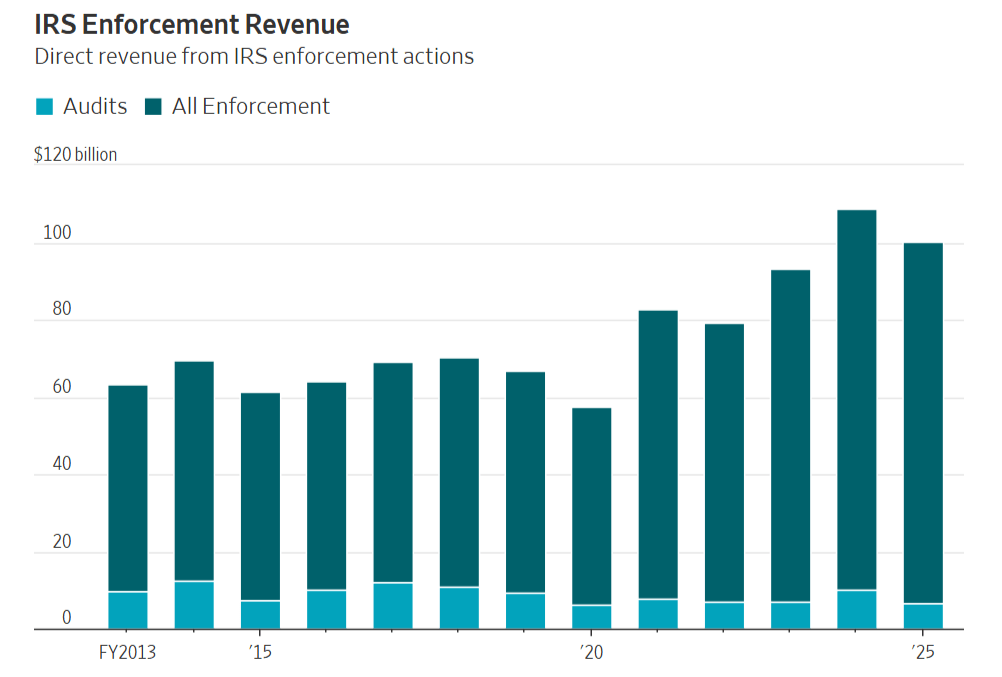
Doing Less With Less
The IRS is investing in data analytics and AI to identify noncompliance and offset staffing losses, but officials and outside observers are skeptical that technology alone can fill the gap. IRS enforcement chief Jarod Koopman acknowledged the tradeoff plainly, saying the agency does “less with less” but hopes smarter technology leads to better outcomes overall. For now, AI can flag potential cases but cannot replace the accountants and lawyers needed to pursue them.
Tax attorneys say the effects of reduced staffing are already visible — fewer audits, faster case closures, mid-case handoffs as agents leave, and in some instances, the IRS allowing legal deadlines to lapse entirely, forfeiting its ability to challenge a taxpayer’s return. As one former IRS official put it, the agency is attempting to maintain some semblance of its prior workload with drastically fewer resources.
Pressure on the System — and a Warning About the Future
A retired IRS revenue agent in the New Orleans area described an agency under pressure to close cases faster, arguing that reduced audit coverage creates openings for abuse. When taxpayers sense they won’t be examined, he suggested, the temptation to misreport grows.
Many tax attorneys, regardless of political leaning, say they prefer a well-resourced IRS — not out of sympathy for the agency, but because knowledgeable, efficient examiners make it easier to resolve disputes on behalf of clients. Several lawyers noted that the appeals process has become increasingly backlogged, with overloaded officers struggling to work through a growing queue of cases.
At the same time, some attorneys say audits that do proceed are becoming more targeted. Agents are asking sharper questions and arriving better prepared, drawing on database searches and publicly available information to focus their inquiries.
Tax lawyers also caution against overstating the retreat in enforcement. The government generally has three years from the date a return is filed to initiate an audit, and longer in certain circumstances. Taxpayers who push boundaries today could still face scrutiny in 2029 or later if enforcement priorities shift again.
Some practitioners worry the damage may prove difficult to reverse. Rebuilding institutional expertise takes years, and recruiting talent back to a diminished agency presents its own challenges. One New York attorney suggested the administration had compressed a complex institution too quickly, leaving lasting structural harm that will not be easy to undo.