
Bloomberg recently reported that the Senate Republicans are pursuing an ambitious strategy to dramatically reduce the apparent fiscal impact of their comprehensive tax legislation through a controversial shift in budget scoring methodology. This approach centers on changing how Congress measures the cost of making President Trump’s 2017 tax cuts permanent.
Under the traditional budget reconciliation process, which allows legislation affecting revenue and mandatory spending to pass the Senate with only 51 votes the GOP megabill is moving to the Senate. Republicans are leveraging a “current policy” baseline rather than the standard “current law” baseline used by congressional scorekeepers.
The distinction is significant: using the current policy baseline, extending the TCJA would look cost-free, although any additional tax cuts would be scored as a cost. This represents a departure from conventional scoring that compares proposed legislation to what would happen if current law remained unchanged, including the scheduled expiration of many 2017 tax provisions after 2025.
The fiscal implications are substantial. Analysis finds the tax provisions would reduce federal tax revenue by $4.0 trillion from 2025 through 2034 on a conventional basis, though on a dynamic basis, incorporating projected economic growth of 0.8 percent, the cost falls to $3.1 trillion.
Traditionally, the cost of such legislation is calculated by comparing it to what would happen under current law. However, Senate Republicans propose starting with a different assumption: that current policy remains in place indefinitely. Under this new baseline, extending the 2017 tax cuts beyond 2025 wouldn’t add to federal deficits, as it would simply maintain the status quo. In contrast, the Joint Committee on Taxation previously estimated that keeping the 2017 rates for another decade would add $3.8 trillion to deficits.
Senate Republicans have already taken steps to implement this approach. The Senate approved a budget resolution that would carve out $1.5 trillion for tax changes using a “current policy” baseline while the amended resolution retains reconciliation instructions directing net tax cuts of $4.5 trillion over 10 years under a “current law” baseline.
This parliamentary strategy raises broader questions about the measurement of fiscal policy and the long-term sustainability of federal budget practices as Republicans work to advance their tax agenda without Democratic support.
If successful, this maneuver would disrupt decades of precedent by sidestepping rules designed to prevent permanent damage to fiscal balances. Economists caution that it would establish a dangerous precedent for future legislation, enabling the majority party to enact seemingly temporary measures and later make them permanent without an official cost assessment.
“It immediately undercuts a lot of the benefit of reconciliation from the perspective of folks who are worried about deficit-finance changes,” said Garrett Watson, director of policy analysis at the Tax Foundation. “That’s why there are those limitations that are currently put in place.”
Fiscal Impact of Tax Cut Extensions
Economic analysts are raising concerns about the long-term fiscal implications of making the 2017 tax cuts permanent. While these extensions might provide modest economic benefits, experts warn they fall short of addressing America’s mounting debt crisis.
Economic Growth vs. Fiscal Reality
According to the Tax Foundation’s analysis, which Watson told Bloomberg News, permanently extending the 2017 tax reductions would yield only marginal improvements in long-term economic growth. However, this slight uptick would be insufficient to offset the substantial budgetary costs, leaving the fundamental debt challenge unresolved.
Competing Cost Estimates
Different analytical approaches have produced varying projections for the fiscal impact:
The Tax Foundation’s preliminary assessment of the Senate proposal estimates a $3.9 trillion price tag over ten years, even after incorporating anticipated economic effects. Meanwhile, the nonpartisan Congressional Budget Office evaluated the House version and projected it would increase federal deficits by $2.8 trillion across the same timeframe.
Legislative Timeline and Scoring Challenges
Senate leadership aims to advance their version of the legislation within the current week, though scheduling may face delays. The Joint Committee on Taxation has evaluated the tax provisions specifically, calculating a $441 billion addition to deficits over the decade. This figure relies on Republican assumptions that treat the extension of existing 2017 tax rates as having no net fiscal cost—a methodology that has drawn scrutiny from budget analysts.
The debate highlights the ongoing tension between tax policy goals and fiscal sustainability as lawmakers navigate competing priorities in an era of significant federal debt.
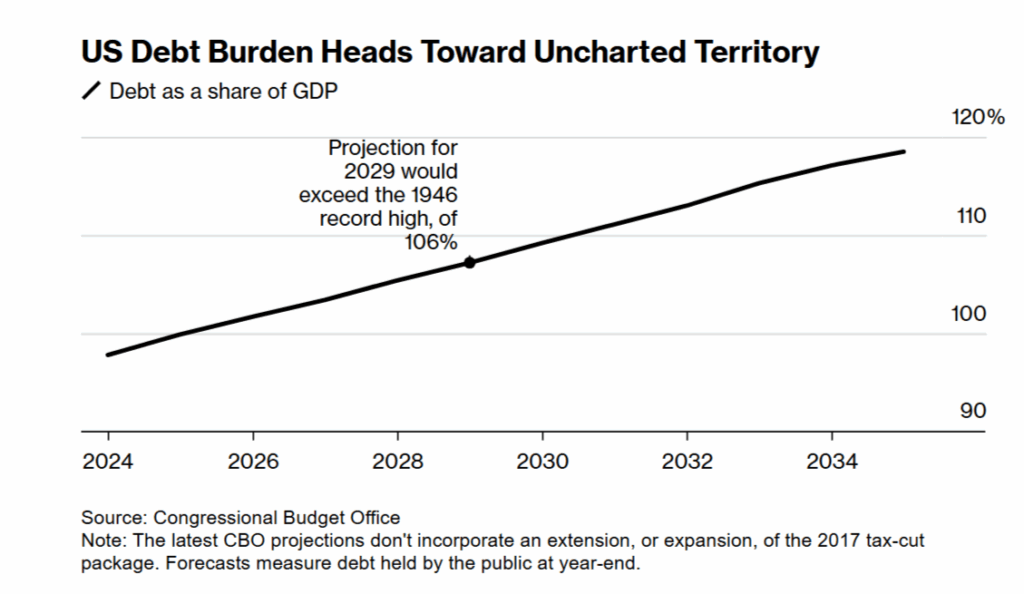
Even without new spending, the U.S. is already on track for a record debt-to-GDP ratio in the coming years. A parliamentary shift that lowers legislative barriers to increased borrowing risks worsening this trend and eroding investor confidence in long-term U.S. Treasuries.
“The key principle in budget accounting is all costs need to be counted at some point,” stated Brendan Duke, senior director for federal fiscal policy at the left-leaning Center on Budget and Policy Priorities. He argued that this move would “ensure that the cost of the tax cuts for 2026, 2027, 2028, 2029 and so on never gets counted.”
It remains unclear whether Senate Parliamentarian Elizabeth MacDonough, who determines what’s permissible in the reconciliation bill, will approve the “current policy baseline.” However, she previously indicated it could be used in the budget-resolution outline that passed the Senate earlier this year.
Republicans Attribute Deficits to ‘Spending Problem’
Republicans maintain that U.S. deficits are a “spending problem,” not a tax issue. Mike Crapo, the GOP chair of the Senate Finance Committee, stated on June 22, “Extending the Trump tax cuts prevents a $4 trillion tax increase — this is not a change in current tax policy or tax revenue.”
However, Democrats argue that certain provisions within the reconciliation legislation, such as a ban on raising deficits after 10 years, necessitate using a “current law” baseline. Analysts suggest the Senate’s tax cuts are likely to violate this rule.
The Senate draft largely mirrors the House-passed provisions but includes several changes. The Senate version makes three business tax breaks permanent, while scaling back breaks for workers and enacting deeper cuts to Medicaid. Additionally, the cap for federal deductions for state and local taxes is expected to be reduced from the $40,000 limit set in the House bill.
This strategic move could pave the way for additional tax-cut benefits in the future. The current Senate bill limits tax breaks on tipped wages and overtime pay to four years to manage the bill’s cost. However, adopting a “current policy baseline” could allow Congress to extend these tax reductions indefinitely at no perceived future cost.