
Grantor-retained annuity trusts, or GRATs, have long been a popular estate-planning strategy among wealthy families looking to transfer appreciating assets to children and other heirs while potentially minimizing gift and estate taxes. But a high-profile case involving a $736 million gift tax assessment is putting renewed attention on how the IRS views these sophisticated wealth-transfer strategies.
According to The Wall Street Journal, the IRS is challenging the use of GRATs by Nashville heiress Trisha Elcan and her husband, Chuck Elcan. The couple is contesting the assessment in U.S. Tax Court, arguing that the GRAT strategies they used to transfer wealth to their three daughters were legitimate.
The Elcan case provides a rare look at how high-net-worth families use advanced estate-planning techniques to transfer wealth and the potential tax consequences when the IRS challenges how those strategies are structured or carried out.
What Is a Grantor-Retained Annuity Trust?
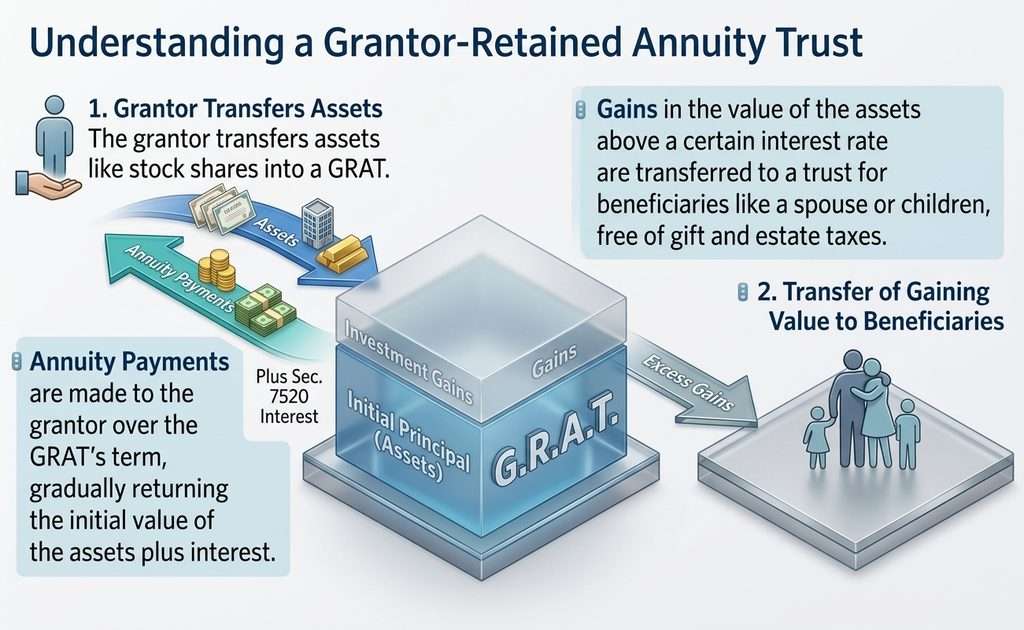
A grantor-retained annuity trust, commonly called a GRAT, is an irrevocable trust designed to transfer appreciating assets to beneficiaries while potentially minimizing gift tax.
The person establishing the trust, known as the grantor, transfers assets into the GRAT and retains the right to receive annuity payments for a specified period. When the trust term ends, any assets remaining in the trust may pass to the beneficiaries. The strategy is designed to take advantage of future appreciation. If assets in the GRAT grow faster than the IRS’s prescribed interest rate, the appreciation above that rate may pass to beneficiaries with little or no additional gift tax.
GRATs can be particularly attractive to business owners, corporate executives, investors and other high-net-worth individuals who hold concentrated stock positions, privately held businesses or other assets they expect to appreciate significantly.
How Do GRATs Work?
GRATs are typically established for a set period, often between two and 10 years, to hold assets that the grantor expects to increase substantially in value.
The potential tax benefit comes from the difference between the asset’s actual growth and the IRS’s prescribed interest rate, known as the Section 7520 rate. For example, the Section 7520 rate was 5.4% for September.
When assets in a GRAT appreciate faster than the applicable IRS rate, the excess growth may pass to beneficiaries with potentially little or no gift or estate tax.
The grantor receives annuity payments from the trust, generally designed to return the value of the original contribution plus the applicable IRS interest rate. Because the grantor retains this annuity interest, the initial transfer can potentially result in little or no taxable gift. Payments generally must be made at least annually.
If the assets don’t outperform the IRS hurdle rate, the GRAT may simply return the contributed assets to the grantor through the annuity payments. In that situation, there may be little or no wealth transferred to beneficiaries, but the grantor generally hasn’t lost the assets simply because the GRAT failed to generate sufficient appreciation.
Some investors use a strategy known as rolling GRATs, establishing new GRATs as existing trusts make their annuity payments. “It’s largely no-regrets planning,” said Mike Kaercher, deputy director of the Tax Law Center at New York University. If a GRAT doesn’t produce the expected appreciation, the assets can potentially be placed into another GRAT.
Why Are GRATs Popular for Wealth Transfer?
GRATs have attracted significant attention among wealthy families because they can potentially move future asset appreciation outside the grantor’s taxable estate while limiting the amount treated as a taxable gift.
The strategy can be especially attractive when an individual owns an asset that is expected to appreciate substantially but has not yet reached its anticipated value. The Biden administration previously proposed restrictions on certain trust and wealth-transfer strategies, including GRATs, estimating that the proposed changes could generate significant federal revenue. Legislative efforts to change the rules have not resulted in a broad overhaul, however, and GRATs remain an important tool in some estate and gift tax planning strategies.
The potential benefits can be substantial when assets experience significant appreciation.
For example, the journal article mentions that a former private-wealth attorney and co-founder of GRATtrack, Louis Laski, estimated that if $1 million of Amazon stock had been placed into two-year rolling GRATs a decade earlier, approximately $4.5 million could have ultimately passed to beneficiaries without gift or estate tax, despite the stock’s significant decline in 2022. Past investment performance, of course, does not guarantee future results. The effectiveness of a GRAT depends on numerous factors, including asset performance, the applicable IRS interest rate, the trust’s structure, and the timing of the transactions.
When Should You Consider a GRAT?
Financial and estate-planning professionals often consider GRATs for individuals with substantial assets who expect their net worth or particular investments to grow rapidly.
The strategy can be particularly relevant for people holding:
- Concentrated stock positions
- Interests in privately held businesses
- Pre-IPO or rapidly growing company shares
- Family business interests
- Other assets expected to appreciate significantly
Some advisors recommend considering GRAT planning before a family’s estate reaches the federal estate tax threshold, although there is no universal net-worth level at which a GRAT becomes appropriate. The right timing depends on the individual’s assets, expected growth, family circumstances, estate plan and overall tax objectives.
What Can Go Wrong With a GRAT?
Although GRATs can offer significant estate-planning benefits, they aren’t risk-free.
One important consideration is the grantor’s death during the GRAT term. Depending on the circumstances and the terms of the trust, some or all of the GRAT assets may be included in the grantor’s taxable estate. This is one reason short-term GRATs, including two-year GRATs, are commonly used.
There are also technical requirements surrounding how GRAT assets are valued, transferred and administered. Another strategy sometimes used with GRATs involves “freezing” appreciation by substituting appreciated assets with cash, bonds or promissory notes. The use of promissory notes is at the center of the Elcan case.
The Elcan GRAT Case
In 2018, Trisha Elcan established three GRATs funded with assets valued at approximately $1.5 billion. The assets were interests in holding companies that owned HCA Healthcare stock.
HCA Healthcare is a major hospital operator that Trisha Elcan’s father and grandfather helped co-found in 1968. According to the couple’s attorney, the first two GRATs generated sufficient appreciation to transfer approximately $200 million to trusts benefiting the couple’s three daughters. The third GRAT, established later that year, did not generate enough appreciation to exceed the applicable hurdle rate.
The IRS is challenging a particular transaction involving the GRATs.
Trisha Elcan purchased assets from the trusts in exchange for interest-bearing promissory notes, which she was required to repay. The GRAT trustee subsequently satisfied annuity obligations by forgiving portions of those notes.
The IRS contends that using the promissory notes in this manner violated regulations governing GRATs. The agency is seeking approximately $614 million in gift taxes plus $122 million in penalties, based on its position that the transfers into the GRATs constituted taxable gifts.
Chuck Elcan also faces potential liability because the couple elected to treat gifts as joint gifts. The Elcans dispute the IRS’s position and argue that the promissory-note transactions were consistent with the tax code and applicable regulations. Their attorney, John Porter, has argued that the IRS’s position would produce what he described as a “draconian result.” The IRS generally does not comment on pending litigation.
Why the Promissory Notes Matter
The use of promissory notes is significant because GRATs are subject to detailed tax rules governing how assets are transferred into and out of the trust.
The Elcans contend that Trisha Elcan’s use of promissory notes was consistent with the tax code and applicable regulations. Court records indicate that she was a frequent user of GRATs, establishing more than one trust in several years between 2010 and at least 2019.
While the case remains pending, some estate-planning professionals have recommended that clients avoid using promissory notes in GRAT transactions and instead use more traditional GRAT structures. Estate attorney Diana Zeydel has said she disagrees with the IRS’s position but would nevertheless caution clients against using notes while the litigation is unresolved. The broader lesson for taxpayers is that the details of a wealth-transfer strategy matter. A strategy that is commonly used does not necessarily mean every variation of that strategy will receive the same tax treatment.
What the Elcan Case Means for GRAT Planning
The Elcan case does not mean that GRATs are no longer a viable estate-planning strategy. Instead, it highlights the importance of carefully structuring and administering these trusts.
For high-net-worth individuals, GRATs can be one component of a broader gift and estate tax planning strategy that may also include:
- Lifetime gifting
- Irrevocable trusts
- Business succession planning
- Family limited partnerships
- Generation-skipping transfer tax planning
- Charitable giving strategies
- Valuation planning for closely held businesses
- Trusts for children and grandchildren
Families with significant business interests or concentrated stock positions may want to evaluate potential wealth-transfer strategies before an asset experiences substantial appreciation.
The Importance of Professional Estate and Tax Planning
GRATs are highly technical estate-planning vehicles. Their potential benefits depend on factors such as the value of the assets transferred, the IRS interest rate, the length of the trust term, expected appreciation, and how the trust is administered.
The Elcan case also demonstrates that proper documentation and compliance are critical when implementing sophisticated estate-planning strategies.
For families considering a GRAT, it is important to coordinate with an experienced CPA, estate-planning attorney, and financial advisor. Each professional can address different aspects of the strategy, from tax reporting and valuation to legal structure and investment considerations.
A GRAT may provide an opportunity to transfer future appreciation to the next generation while potentially reducing gift and estate tax exposure. But it should be evaluated as part of a comprehensive estate plan rather than as a stand-alone tax strategy.
As the Elcan litigation continues, the case could provide additional insight into how the IRS approaches certain GRAT structures and the limits of these wealth-transfer techniques. If you have questions about your specific circumstances, reach out to Huckabee CPA for a free consultation.